Showing posts with label classic cars. Show all posts

Wednesday, March 30, 2011

Doors-aster? The First Attempt at Door Restoration

With the interior ferried safely away to the TAFE college, and the vinyl purchased, the doors would need to be completed in time for the students to test fit the door trims.

Now, unlike the fibreglass/steel combination body, the doors were an all steel creation, with skins unique to the Equipe, welded to Herald frames. With the doors stripped and blasted, it was possible to see a minor amount of rust in the drivers side door (skin and inside), and a gouge in the passenger side door. There was nothing major, with a few minor dents inside to both doors.

Not as horrible inside as I thought. Phew!

With the students pending, I decided to send the doors direct to a panel beater for repair and painting. I purchased enough paint to do the whole car and proceeded to procure quotes. The first was $1000 PER DOOR. The hours and expense just did not add up, so I went to the next guy. WORSE! Surely these guys were having a lend? I was beginning to despair when someone told me of a chap who did great 'hot rod spec' work for cash.

I visited, checked out his work, and was very impressed. A price of $1000 for the pair was agreed, including re-welding the quarter vent frames (which had fallen apart on removal), and off I went. This is where my appreciation of concourse restorations really began to grow. The doors languished for months. Despite regular calls from me to look at progress, so I could take restoration snaps. The delays continued until, suddenly "you can pick 'em up".

Initially, all seemed pretty good, but I looked closer. Firstly, around 2-litres of 2K was used in the job - half of what I'd purchased to do the entire car! The dents on the inside of the doors remained untouched and a thick coat of orange peel sprayed over top. The frames were re-welded incorrectly and did not fit into the doors, or the glass. The finish outside of each doors was magnificent, except the lower edges had not been painted (or the paint had been buffed away), and holes from an aftermarket mirror remained unfilled. I have no idea what is underneath the paint - most likely bog (bondo).

"Whaddaya expect for $1000" was the excuse provided. Well, dents removed, holes filled and consistent paint for a start!

Nice 'n' shiny on the outside, and passes the magnet test, so any bog is only thin. If only they'd got the inside nicely finished and dent free. I may try a crash repairer to see if the dents can be removed without damage.

However, I'm less positive about the frames. NOTE: The upper frame is designed to fit inside the other...with the job they've done, what do you think the chances of that are??? Honestly - just check your work guys!

It became apparent that, paying and asking for a good job, being diligent and putting in the prep work, was not enough to guarantee any kind of quality, at all. Lesson learnt. It also became apparent, I'd be coming back here forever, if I wanted the job done properly. So, took my doors home and put them in storage - a nervous wait trying to keep them scratch free until final assembly!

However, I'll probably need to purchase more paint, and re-do the lot. Sigh.

Meanwhile, the glass from each door was scratched beyond economical repair, so quarter vents were polished, main glass replaced. All rubber parts were obtained through Fitch the Rubber Man (can't recommend them more highly) or the UK (thanks again to Guy, for the unobtainable quarter vent rubbers, unique to Bond), and some diligent cleaning got all moving parts working again.

Zinc plated parts are still pending, but there's no need to rush as, unfortunately, the TAFE upholstery course had only one student enrol, and they soon withdrew. I was stranded, so I collected all my parts and returned home. Sigh, again.

I now know the restoration process, especially if the work is out of your hands, is a series of wins and losses...no matter how hard you push, some things just don't go the way you want them too. However, some wins were just around the corner.

Saturday, March 26, 2011

Bond - The Industrial Design Link

Being an Industrial Designer, or just an all-round car geek, I have an avid interest in the (sometimes) secret design history behind the cars I've owned. I guess most of us assume our cars, no matter how 'classic' or full of character they may be, have been designed by a faceless committee or Engineering Department. Increasingly, this is the case, but more often than you'd expect, there's an interesting design story behind our cars.

The Bond Equipe GT is a good example.

The rare Invisi-Bond Equipe!

Bond introduced the 4-cylinder Equipe to its range in 1963, based on a Triumph Herald, as an addition to it's range of oddball 3-wheeler Minicar's. The car was a rather humble, if stylish little machine, designed to fill a budget fastback market niche. It continued to improve over the years, but the release of Triumph's 6-cylinder Herald variant, the Triumph Vitesse, gave Bond the chance to lift the profile of their range with a more luxurious grand turismo. So Bond called in designer Trevor Fiore.

Fiore's claims to fame were few at this stage, although he was well publicised due to his new TVR Trident concept (a car that went on to become the Trident Clipper). Bond were keen on this concept and called in Fiore to adapt the design to the Vitesse's chassis and scuttle. Frustratingly, the results seemed not to anyone's satisfaction - Fiore departed, leaving Bond draftsman (or draughtsman, if you prefer) Alan Pounder to join all the pieces together.

The Trident Clipper - never mind the gate, just look at the size of those tyres!

Alan Pounder may have felt his role in the company somewhat diminished, as he's constantly referred to as their 'draftsman' (actually officially Chief Design and Development Engineer), despite his styling, engineering, prototyping and testing roles - Nick Wotherspoon's book features a great picture of him testing an early Bond 'jetski' wearing a gnarly cable knit sweater! Fiore went on to productionize the Trident in 1967, plus styling Elva's Elva-BMW GT160 (1968), the magnificent Monteverdi Hai (1969), and the insane Citroen Karin (1980), before vanishing off the scene completely.

The result of Pounder's adaptation the Equipe...well...kinda looks like a TVR Trident stuck to a Vitesse, I'm afraid, but a unique and not unattractive end result. It was favourably received on release in mid-1967, being discontinued in 1970 when Bond Cars was purchased and wound down by Reliant (a British competitor, who purchased Bond about 12 months earlier). It featured a fibreglass/steel construction (so can rust as well as crack) and suffered from all the same afflictions as a Herald/Vitesse (yes, that perilous swing axle rear end). Unique design features were gutter-free windows (for early models, they gave up eventually) and an incorporated aerial (glasses into the rear R/H 'C' pillar).

Bond had one last hurrah, when Reliant released Tom Karen's iconic 3-wheeler, the Bond Bug (1970 - 1974). Although it was Reliant conceived (and powered), still not a bad way to go.

Behold, the Bug! Some of our friends up North don't like these babies getting out of the Kingdom, but I'll import a Bug here one day (just don't tell the missus). PS: Let me know if this is your car - any copyright infringement is absolutely unintentional!

As an aside, Bond Minicar's were imported into Australia for a short period in the early 1950's. Several 4-cylinder Equipe's are in the country, plus at least 2 Bond Bugs - if there are any more 6-cylinder Equipes, I'd love to know!

So, there you have it, the design history of the Bond Equipe GT in a nutshell.

Have a look at the Bong Bug forum HERE, with some information on Tom Karen too, designer of the Bug and the Raleigh Chopper. Woot!!!

Tuesday, March 22, 2011

Got Broken 'glass? Call Composite Solutions!

Faced with a gaping hole and no knowledge of fibreglass, I needed to work out where to go next. The parts had now arrived from the UK (via Canberra - cheers Graham, Russell and Ian), and almost covered the extensive damage, but how to stick it all back together was anyone's guess.

When I was a youngster, I used to know a chap who owned a fibreglass bodied Bolwell Mk.7, and knowing the marques strong following in SA, thought I'd turn to the Bolwell Car Club for some assistance. They pointed me in the direction of master 'glasser, Norm Clement, of Composite Solutions. Norm had a quick look, in a very sage-like manner, and agreed it could be fixed and signed up for the job. Within weeks we were to commence.

Meanwhile, the car needed to be partially stripped. Now, I must say that my intention had never been to attempt a restoration from the inside out, but circumstances dictated a unique approach. So, the interior was next.

I took up an offer from a local TAFE college lecturer (Joe Maurici) to use the car for an upholstery class, free of charge, I only need supply materials. The downside was that the job could take as long as 12 months, but I had time on my side. I couldn't leave the car with the TAFE guys for refitting, as I'd need to strip it out as soon as they'd finished! So, we decided to strip out the interior to be re-upholstered, and also provide the doors for trim fitting.

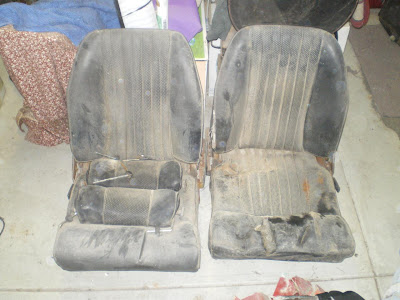
Removing the front seats, I found they were not original, but a period after-market Microcell reclining seat (with trendy headrests, which had fallen off), as later fitted to the Radford Mini Deville. The seat frames had been fabricated from wood - not quite up with ADR's, even for 1968, I'd imagine. Besides, they were in lousy shape.

A few buckets worth of mud didn't go astray either! Yuck

Ultimately, I was on the lookout for a pair of original Bond seats which, whilst they were non-reclining, looked 300% cooler.

Removing the back seat I found the steel below consisted of several thousand rust flakes precariously balanced, both below and inside the seat squab itself! Some MAJOR work required here.

A rust relief sculpture greeted me below the rear seat squab

Below all this mess are brackets for the handbrake cable, so will need to accurately fabricate the entire panel - spares are not available.

Other discoveries included, a gaping hole in the driver's side floor (accelerator pedal hanging beneath the car!), incorrect gearbox (possibly Triumph 2000), modified floor to fit said oversized gearbox, cardboard transmission hump cover all but disintegrated (fibreglass replacement purchased from Triumph Vanguard Wholesalers), Bond centre console gone (if ever present) and the cardboard dashboard fell apart in my hands (fibreglass replacement also purchased from TVW).

AM radio, now all I need is an 8-track!

The original leather wheel was falling apart, centre bezel and horn button turned to chalk, and wheel boss a chewed out piece of aluminium. Guy came to the rescue with an owners manual and console, but a wheel would require a lot of research, and a lot of patience.

I purchased some Nylex MG and Triumph basketweave vinyl for the TAFE guys to use, piled all the bits into my stylish Hyundai wagon and away it all went - with the exception of the rear seat (frame given to a local metal fab shop to make a new frame) and fibreglass dashboard (given to my dad to plane the wood insert to size - the cavity in the 'glass dash being a little undersize). The doors were removed, stripped, blasted and etch primed, ready for the panel beaters.